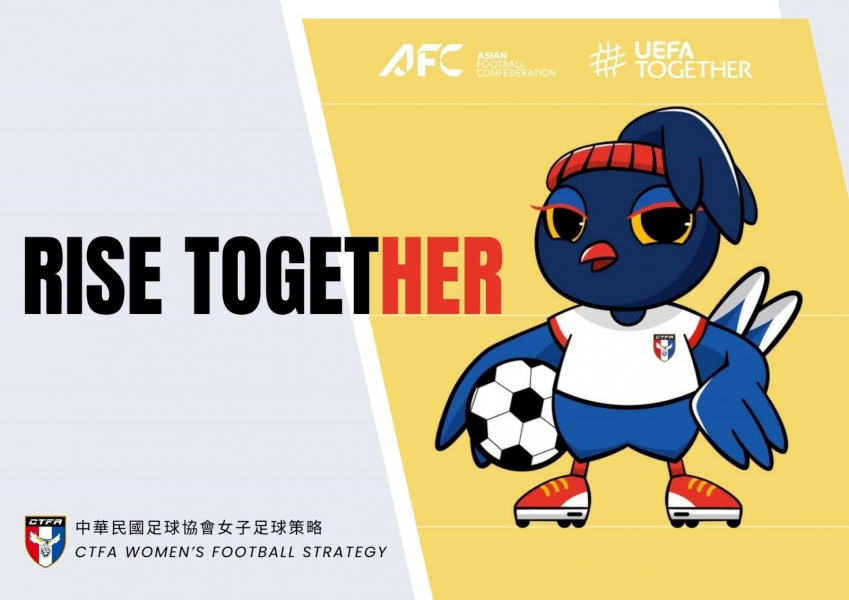
Hot on the heels of Taiwan women’s crunching 8-0 victory over Pakistan, the Chinese Taipei Football Association (CTFA) have released a white paper that would overhaul the management of women’s football on the island if implemented fully.
In interviews accompanying the release of the white paper, Wang Ling-hsiang, the head of the CTFA, was bullish regarding his organization’s vision, insisting that the proposals are ‘a commitment [from] the Chinese Taipei Football Association to female players and the football community across the country’.
The document, which took eighteen months to draft and involved discussions with both the governing bodies of both Asian (AFC) and European (UEFA) football, proposed a number of eye-catching targets.
- Making football the most popular women’s team sport in the country by 2030
- Achieving 10,000 registered female players and coaches.
- The women’s national team to be ranked among the top 30 nations in FIFA
- Taiwanese womens’ national teams at all levels regularly qualifying for continental tournaments like the AFC Cup.
- Making the Mulan League one of the top five leagues in Asia, with at least 50% of the players being on professional contracts
Whilst these targets are ambitious, they also reflect the potential that many see within women’s football on the island. Indeed, during the 1990s, the Mulan were among the best women’s teams in the world and made it to the quarter-finals of the inaugural World Cup in 1991. They also finished as runners up in the 1989 and 1999 AFC Finals, third-place in 1991 and 1995, and fourth in 1993 and 1997.
As the women’s game professionalized and adopted higher standards, Taiwan has fallen behind and the white paper will be an attempt to gradually drag the Mulan back into being a credible side on a global level, let alone an Asian level.
It should be noted that there is little information about where funding will come from. This is a critical point given that professionalizing the domestic league would be expensive and making football the top sport for girls on the island will also require significant financial investment at the grassroots levels.
That being said, this is still encouraging. The CTFA have clearly realized that major changes are needed. They also have sensed that with the right support, Taiwan could eventually become a legitimate contender in the Asian region rather than a plucky underdog when compared with the stronger sides like Japan, China or Australia.
 Email: formosafootballblog@gmail.com